Hydrofit Products Manufacturer
Contact : +91-79045 61980
Email: hydrofitengineers@gmail.com
Hydraulic Fittings DIN 2353
Precision Tube Connections for Industrial Hydraulic Systems
In a hydraulic system, a connection should not be judged only by whether it stops oil from leaking on the day of installation. The actual test comes after repeated pressure cycles, machine vibration, temperature variation and regular maintenance work.
This is where Hydraulic Fittings DIN 2353 are widely used. The system provides a mechanical connection between precision hydraulic tubing and equipment without requiring the tube joint itself to be welded.
For an engineer selecting a DIN 2353 fitting, the fitting body, nut, cutting ring, tube outside diameter, tube condition and assembly method have to work together. A correctly manufactured fitting installed on an unsuitable tube can still produce an unreliable connection.
Hydrofit Engineers supplies DIN 2353 ferrule fittings for industrial hydraulic applications in carbon steel, SS 304, SS 316, SS 316L and brass options depending on the application requirement.
How a DIN 2353 Hydraulic Connection Works
The sealing principle of a DIN 2353 fitting is mechanical.
During assembly, the nut moves the cutting ring towards the cone of the fitting body. As tightening continues, the cutting edge engages with the outside surface of the tube. This creates a mechanical grip that helps hold the tube against axial movement and hydraulic pressure.
This is why tube preparation is just as important as fitting quality.
An incorrectly cut tube, damaged outside surface or unsuitable tube dimension can affect the joint even when the fitting itself has been manufactured correctly. Tightening a poor connection further is not a proper repair method and can damage both the ferrule and the fitting body.
Hydrofit’s Hydraulic Ferrule Fittings are closely related to this connection principle and are used in hydraulic systems where secure tube grip and reliable sealing are required.
Why Hydraulic Tubes Matter in DIN 2353 Assemblies
A common purchasing mistake is to order the fitting first and treat the hydraulic tube as a separate commodity.
In a DIN 2353 connection, the tube becomes part of the joint itself.
Tube outside diameter, wall thickness, material grade, roundness and external surface condition can all influence assembly quality. This is one of the reasons precision hydraulic tubes are specified differently from general purpose steel piping.
Hydraulic tubes are generally identified by outside diameter and wall thickness. The fitting must therefore correspond to the tube dimensions for which the connection has been designed.
Hydrofit Engineers also supplies Hydraulic Seamless Tubes manufactured to DIN 2391 and EN 10305 requirements. The range includes ST37/E235 and ST52/E355 grades for hydraulic and engineering applications.
Hydraulic Tubes, Hydraulic Pipes and Seamless Tubes
During industrial purchasing, the terms hydraulic tubes, hydraulic pipes, seamless tubes and seamless pipes are often used for similar requirements. Technically, however, they should not automatically be treated as the same product.
Hydraulic Tubes
Hydraulic tubes are normally specified by outside diameter and wall thickness. Outside diameter is particularly important because the cutting ring of a DIN 2353 fitting has to grip the tube correctly.
Hydraulic Pipes
Hydraulic pipes are commonly associated with nominal pipe sizing. The dimensional convention is different from precision hydraulic tubing, so a pipe should not be selected only because its approximate diameter appears similar to an existing tube.
Seamless Tubes and Seamless Pipes
The term seamless refers to the construction of the tube or pipe. A seamless product has no longitudinal welded seam, but seamless construction alone does not confirm that the material is suitable for a DIN 2353 hydraulic connection.
The material grade, dimensional tolerance, wall thickness, surface condition and hydraulic application must still be verified.
DIN 2353 Fittings and BSP Hydraulic Pipe Fittings Are Different
DIN 2353 and BSP fittings may both be used within the same hydraulic system, but they perform different connection functions.
DIN 2353 fittings are primarily associated with hydraulic tube connections using a mechanical cutting ring system.
BSP fittings, on the other hand, are threaded connection components commonly used between pumps, valves, manifolds, adapters and other hydraulic equipment.
For threaded hydraulic connections, Hydrofit Engineers also supplies Hydraulic Pipe Fittings BSP Thread for industrial fluid power systems.
BSP and DIN 2353 connections should not be treated as interchangeable simply because they are both hydraulic fittings.
Material Selection for DIN 2353 Hydraulic Fittings
There is no single material suitable for every hydraulic system. The correct selection depends on pressure, hydraulic fluid, operating environment, corrosion exposure and tube material.
Carbon Steel DIN 2353 Fittings
Carbon steel fittings are commonly used in industrial hydraulic systems where mechanical strength and commercial practicality are important.
Stainless Steel DIN 2353 Fittings
Stainless steel becomes important where corrosion resistance is required. Depending on the application, SS 304, SS 316 and SS 316L can be considered.
Brass Fittings
Brass fittings may be selected for specific fluid handling and lower pressure applications where compatibility and corrosion behaviour suit the system requirement.
Material selection should always consider the complete tube and fitting assembly rather than the fitting alone.
Light and Heavy Series DIN 2353 Fittings
Two hydraulic systems can use the same tube outside diameter and still operate under completely different conditions.
A machine tool may experience relatively stable hydraulic pressure, while construction equipment or heavy industrial machinery can face repeated shock loading, pressure cycling and vibration.
This is why DIN 2353 fittings are available in different series to suit different pressure and application requirements.
Light Series
Light series fittings are commonly selected for applications where pressure requirements are lower and the hydraulic circuit does not experience severe mechanical loading.
Heavy Series
Heavy series fittings are used where higher pressure capability and stronger tube connection performance are required.
Selection should be based on the actual tube size, material, working pressure and application rather than choosing a series only by fitting shape.
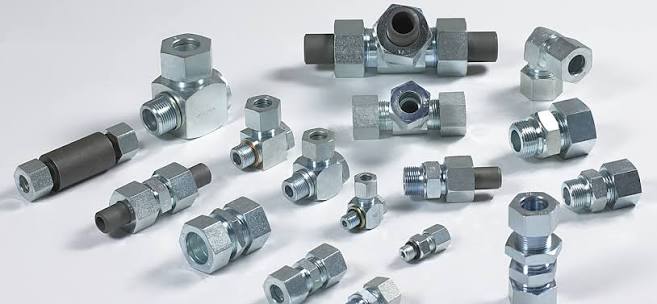
Common DIN 2353 Fitting Configurations
DIN 2353 fittings are available in different configurations depending on hydraulic line routing and equipment design.
- Straight connectors
- Equal unions
- Reducing unions
- Elbows
- Equal tees
- Reducing tees
- Bulkhead fittings
- Male connectors
- Female connectors
- Adjustable fittings
The correct configuration should minimize unnecessary joints and allow proper tube alignment throughout the hydraulic circuit.
Tube Preparation Can Decide Whether the Connection Works
A precision hydraulic fitting cannot compensate for poor workmanship at the tube end.
Before assembly, the tube should be inspected and prepared according to the fitting procedure. Poor cutting, burrs, damaged outside surfaces or incorrect tube dimensions can interfere with proper ferrule engagement.
Tube Cutting
The tube should be cut square. Angled cutting can prevent proper seating inside the fitting body.
Deburring
Internal and external burrs should be removed without damaging the tube surface where the cutting ring has to grip.
Tube Alignment
The tube should enter the fitting without being forced into position. Misalignment places continuous mechanical stress on the connection after installation.
Tube Support
Long unsupported tube sections can vibrate and transfer cyclic load to fittings. Properly positioned Hydraulic Pipe Tube Clamps help control tube movement and maintain organised hydraulic line routing.
Where DIN 2353 Hydraulic Fittings Are Used
DIN 2353 hydraulic fittings are used across a wide range of fluid power systems where rigid hydraulic tubing requires a secure mechanical connection.
- Hydraulic power packs
- Industrial presses
- Machine tools
- Construction machinery
- Material handling equipment
- Steel plants
- Manufacturing machinery
- Automotive production equipment
- Marine hydraulic systems
- Industrial automation systems
What Procurement Teams Should Specify Before Ordering
An enquiry stating only “DIN fitting 12 mm” does not provide enough information for correct product selection.
A proper technical enquiry should include:
- Tube outside diameter
- Tube wall thickness
- Required fitting configuration
- Material grade
- Thread connection details
- Working pressure
- Hydraulic fluid
- Operating environment
- Quantity required
For replacement applications, sharing an existing fitting sample, machine specification or engineering drawing can reduce the possibility of selecting an incorrect configuration.
Choosing DIN 2353 Fittings as a Complete Connection System
A reliable hydraulic line should be considered as a complete assembly rather than a collection of individual components.
The engineering sequence is:
- Select the correct hydraulic tube.
- Confirm tube outside diameter and wall thickness.
- Choose the appropriate DIN 2353 fitting series.
- Verify fitting material and thread configuration.
- Prepare the tube correctly.
- Provide proper tube support.
- Assemble according to the fitting procedure.
Each stage affects the reliability of the final hydraulic connection.
Hydraulic Fittings DIN 2353 Manufacturer and Supplier in India
Hydrofit Engineers supplies Hydraulic Fittings DIN 2353 in India for industrial hydraulic systems along with ferrule fittings, hydraulic seamless tubes, BSP fittings and tube support components.
For industries searching for a Hydraulic Fittings DIN 2353 manufacturer in Chennai, product selection should go beyond simple size availability. Tube dimensions, material grade, fitting series, thread configuration and working conditions should all be considered before installation.
Correct selection at the purchasing stage helps reduce leakage, installation errors and repeated maintenance later.
Frequently Asked Questions About Hydraulic Fittings DIN 2353
What are Hydraulic Fittings DIN 2353?
DIN 2353 hydraulic fittings are precision tube connection fittings used in hydraulic systems. A typical assembly uses a fitting body, cutting ring or ferrule and nut to establish a mechanically secured connection with hydraulic tubing.
Are DIN 2353 fittings the same as hydraulic ferrule fittings?
DIN 2353 fittings use a ferrule or cutting ring connection principle, so the product families are closely related. DIN 2353 refers to a standardized tube fitting system, while ferrule fitting is a broader term for fittings that use a ferrule to grip or seal tubing.
Can DIN 2353 fittings be used with hydraulic seamless tubes?
Yes. Hydraulic seamless tubes are commonly used with DIN 2353 fittings, provided the tube outside diameter, wall thickness, material condition and dimensions are suitable for the selected fitting and application.
Are hydraulic pipes and hydraulic tubes the same?
No. Hydraulic tubes are generally specified by outside diameter and wall thickness, while pipes normally follow nominal sizing conventions. The required dimensions should be confirmed before selecting a DIN 2353 fitting.
Which materials are available for DIN 2353 fittings?
Depending on the application, Hydrofit Engineers supplies fitting options in carbon steel, SS 304, SS 316, SS 316L and brass.
What information should I provide when requesting DIN 2353 fittings?
Provide the tube OD, fitting type, material, thread or connection requirement, operating application and required quantity. For replacements, a sample or technical drawing can help identify the correct fitting.
Hydraulic Products
- Hydraulic Fittings
- Quick Release Couplings
- Stucchi Quick Release Couplings
- Holmbury Quick Release Couplings
- Faster Quick Release Couplings
- Hydraulic Quick Release Couplings
- Pneumatic Quick Release Couplings
- Dry Quick Disconnect Couplings
- Double Check Valve Quick Release Couplings
- Quick Release Couplings for Agriculture
- Quick Release Couplings for Water
- Quick Release Couplings for Gas Applications
- Single Check Valve Quick Release Coupling
- Hydraulic Tube & Pipes
- Hydraulic Hose Assembly
- Hydraulic Hoses
- High Pressure Valves
- Hydraulic Pumps
- Hydraulic Tube & Pipe Clamps
- Hydraulic Flanges
- Hydraulic Accessories
- Hydraulic Valves
- Hydraulic Motor