Hydraulic leaks do not always start with a damaged hose or poor quality fitting. In many systems, the problem begins much earlier, when the wrong connection type is selected for the pressure, vibration and maintenance conditions of the machine.
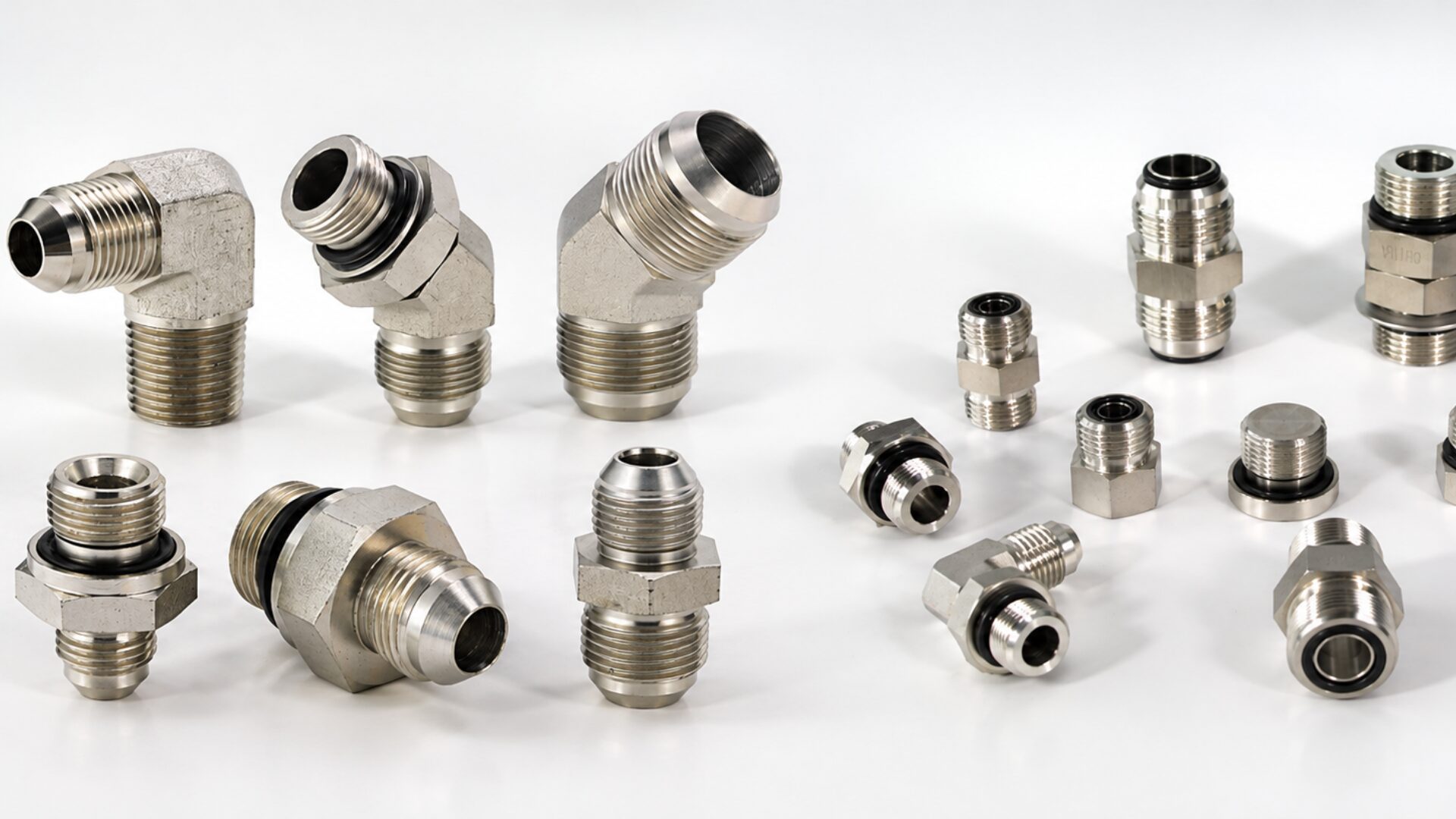
Two connection styles frequently encountered in industrial hydraulic systems are JIC hydraulic fittings and ORFS hydraulic fittings. Both are proven connection methods, but they seal differently and should not be treated as interchangeable choices.
For Indian buyers sourcing fittings for hydraulic machinery, power packs, construction equipment or industrial systems, understanding this difference can prevent unnecessary leakage, maintenance and replacement work.
The Main Difference Is in the Sealing Method
A JIC fitting uses a 37 degree flare connection. The hydraulic tube is flared and the metal surfaces of the male and female connection come together to create the seal.
There is no separate O ring at the primary sealing surface. Correct tube preparation, flare quality, alignment and tightening are therefore important for obtaining a reliable connection.
An ORFS hydraulic fitting, or O Ring Face Seal fitting, works differently. The male fitting has a flat sealing face with an O ring. When the connection is assembled, the O ring is compressed against the flat face of the mating fitting.
This difference in sealing method is the most important point to understand before comparing the two.
| Selection Point | JIC Fittings | ORFS Fittings |
|---|---|---|
| Sealing Principle | Metal to metal flare seal | O ring face seal |
| Connection | 37 degree flare | Flat face connection |
| Seal Element | No O ring at primary sealing face | O ring |
| Tube Preparation | Requires correct flaring | ORFS compatible tube end preparation |
| Typical Consideration | Practical, established hydraulic connection | Strong leakage control in demanding systems |
| Maintenance Concern | Flare condition and alignment | O ring condition and sealing face |
When JIC Fittings Make Practical Sense
Hydraulic JIC fittings are widely used in fluid power systems because the 37 degree flare connection provides a compact and serviceable hydraulic joint.
They can be a practical choice for machinery where JIC connections are already part of the equipment design. They are also useful when maintenance teams are familiar with flared tube connections and replacement components need to match an existing JIC system.
However, installation quality matters.
A damaged flare, incorrect flare angle, poor tube preparation or misalignment can affect sealing. Simply applying more tightening force is not the correct solution for a connection that has not been prepared properly.
For buyers maintaining imported equipment, it is also important to identify the connection standard correctly before ordering. A fitting that appears similar externally is not necessarily compatible with a JIC connection.
Where ORFS Fittings Have an Advantage
The design of Hydraulic ORFS Fittings makes them particularly useful where leakage control is a major consideration.
Instead of relying on direct metal to metal contact at the sealing point, the connection uses an O ring compressed between flat mating faces. This sealing arrangement can perform well in hydraulic systems exposed to pressure changes and vibration when the fitting is correctly selected and assembled.
This makes ORFS worth considering for mobile equipment, material handling machinery, construction equipment and other demanding hydraulic installations.
There is still no reason to assume that ORFS is automatically the better fitting for every machine. The equipment design, pressure requirement, tube or hose arrangement, seal compatibility and availability of matching components all matter.
The O ring itself must also be suitable for the hydraulic fluid and operating temperature.
Should an Existing JIC System Be Changed to ORFS?
Usually, this should not be the first question.
If an existing machine was engineered around JIC connections and those connections are working reliably, replacing every fitting simply to move to ORFS may add unnecessary cost and complexity.
Instead, investigate why a connection is failing.
Repeated leakage from a JIC connection may be related to damaged sealing surfaces, incorrect tube flaring, alignment, vibration or improper assembly. Changing the fitting type without identifying the actual cause may not solve the underlying problem.
For a new hydraulic system, however, engineers have more freedom to evaluate JIC and ORFS based on operating conditions and maintenance expectations.
What Indian Buyers Should Check Before Ordering
For procurement teams, the fitting name alone is not enough. Before placing an order, confirm the connection standard, fitting size, thread, tube or hose dimensions, material, working pressure, hydraulic fluid and operating temperature.
It is also useful to provide the fitting configuration required, such as straight connector, elbow, tee or adapter.
For replacement requirements, a sample, equipment drawing or clear dimensional information can help avoid ordering a fitting that looks similar but uses a different sealing system.
Hydrofit Engineers supplies different types of Hydraulic Fittings for industrial fluid power applications, including Hydraulic JIC Fittings, Hydraulic ORFS Fittings, DIN 2353 Hydraulic Fittings and Hydraulic BSP Fittings. Buyers can therefore compare the connection requirement rather than selecting a fitting based only on thread appearance or price.
JIC or ORFS: Focus on the Application
The practical choice is not about declaring one connection universally superior.
Choose a JIC fitting when the equipment is designed around a 37 degree flare connection and the system can be assembled and maintained correctly.
Consider ORFS fittings where the equipment design calls for a face seal connection and leakage control under demanding hydraulic conditions is an important requirement.
Most importantly, do not mix connection systems simply because two fittings appear to have similar dimensions. Matching the fitting to the machine, operating conditions and mating connection is more important than choosing whichever fitting is easiest to source.
For new installations or replacement requirements, Hydrofit Engineers can assist industrial buyers in selecting suitable hydraulic fittings based on connection type, size, pressure, material and application.