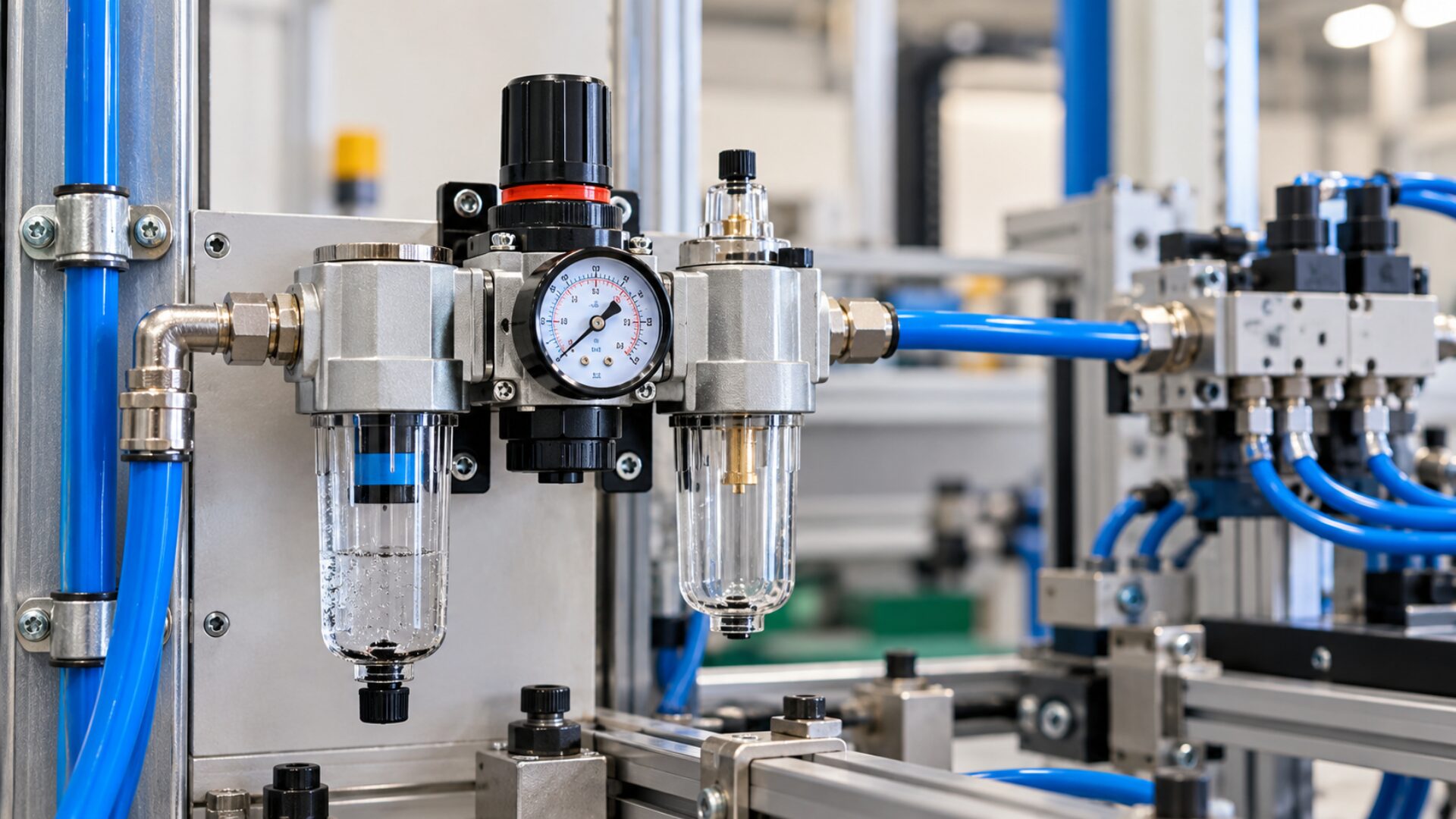
Choosing the right Pneumatic FRL Unit is essential to avoid costly machine downtime and unnecessary wear. Start by assessing your machine’s air demand rather than relying solely on standard catalog sizes. Pay attention to key specs like flow capacity and downstream pressure requirements. If you get it wrong, you might face pressure loss or moisture entering critical components, which can cost you a lot of time and money in the long run.
Pneumatic FRL Unit sizing: don’t start with the catalog
Base your choice on your machine’s actual air demand, not just what’s commonly available. Many products feature 1/4″ BSP units, but these might not suit every tool or setup. Flow capacity should match peak demand. Don’t forget to check downstream pressure requirements and allowable pressure drop, especially when running multiple actuators at once.
Look at specifications like pressure rating, bowl size, gauge, and mounting style. Modular or panel-mount units can save time during maintenance, which is crucial in tight Indian shop-floor layouts.
When a Pneumatic FRL Unit should include a lubricator
The debate often revolves around whether a lubricator is necessary. Use the filter-regulator only if your valves, cylinders, or tools are designed for dry or pre-lubricated air. Adding a lubricator when it’s unnecessary can raise maintenance needs and risk contaminating processes.
Make sure to place the lubricator last in the assembly. This way, oil doesn’t get stripped out by earlier stages. If your air supply is wet, ensure you specify a dryer upstream; filters won’t eliminate water vapour.
What to compare when buying a Pneumatic FRL Unit in India
Check how bowl drains work: manual draining weekly or auto-drain for high-duty needs? Ask suppliers about how often filter elements need replacing; many suggest annual changes or swapping them out when saturation signals appear.
Treat online prices as rough guides rather than fixed numbers; entry-level FRL combos start near ₹396+ GST. Consider reputable suppliers like Ahuja Group for premium options, Aira Euro Automation for locally made units, and SPAC/Shri Narayan Machinery for more budget-friendly choices.
Select the Right FRL Unit for Your Operations
Identify your specific needs, then assess your air quality. Make sure the FRL unit is adequately sized based on flow demands and usage patterns. Don’t settle for generic options if they don’t match your requirements.
Common questions
Do I need a lubricator in every Pneumatic FRL Unit?
No; many modern pneumatic systems work well with dry, filtered air. Only add lubrication if downstream equipment specifically requires an oil mist. If you do use one, make sure it’s the last element in the unit.
Will an FRL remove water from compressed air?
It removes liquid moisture droplets and contamination but won’t eliminate water vapour. If your air supply is wet, consider specifying a refrigeration or adsorption dryer upstream; filters can’t act as dryers.
Why do many Indian suppliers list 1/4 inch BSP FRL units?
It’s common because 1/4″ BSP represents a low-flow entry size for machines in India. It’s handy for compact equipment but shouldn’t be selected just because it’s widely used. Instead, let flow demand, pressure drop, and service access guide your final decision. For more information on hydraulic fittings, you can refer to Hydraulic Fittings: How to Choose BSP vs JIC vs ORFS vs DIN 2353 or Types of Hydraulic Fittings Used in Industrial Applications.